

Original article
Why does weight fail to decrease despite exercise? Could this fatigue-related substance be the reason?
“Lactic acid: a fatigue-related substance said to build up after exercise!”
Most people today experience fatigue to some degree.
The original article attributes this to fatigue-related substances such as lactic acid and free radicals.
When tired, people turn to their own ways of recovering,
including exercise, sleep or enjoyable food.
However, an unsuitable approach can make fatigue worse,
so take care: it may lead to chronic fatigue.
The article equates the familiar expression “fatigue has built up” with “fatigue-related substances have built up.”
It uses that term to describe various waste products and hormones said to cause fatigue or interfere with recovery.
It identifies lactic acid as a representative example.
With substantial exercise or stress, the body uses more oxygen.
The article states that this leaves insufficient oxygen to break down lactic acid, allowing it to accumulate in muscles.
It attributes muscle tightness, aching and stiffness to increased lactic acid.
It also associates its accumulation with fatigue, headaches, swelling and other symptoms.
How the article proposes reducing the fatigue-related substance “lactic acid”
Many people exercise to relieve fatigue.
Exercise loosens tight muscles, supports metabolism and can help recovery.
However, adjust intensity to your physical condition.
When your physical energy is depleted, rather than demanding activity
such as aerobic exercise or strength training, the article recommends relaxing movement such as stretching or yoga.
Conversely, if you still have physical energy but mental stress is leading you toward alcohol, smoking or high-calorie food,
the article suggests more vigorous exercise to release that stress.
Exercise releases chemicals such as dopamine and endorphins, described here as happiness hormones, and helps reduce stress.
The article recommends exercising at least three times a week and suggests that, instead of exercising alone,
doing so in places with other people, such as a swimming pool, gym or park, may be more effective.
If other symptoms, such as headache or reduced appetite, accompany fatigue, seek an accurate assessment
to check for other conditions. If severe fatigue continues without an identified disease,
appropriate assessment and treatment at a chronic-fatigue clinic may help.
YONSEI SaeBom Medical Clinic's chronic-fatigue clinic describes its service as detailed chronic-fatigue testing beyond routine tests,
identifying underlying causes and providing individually tailored treatment.
Visit the YONSEI SaeBom Medical Clinic chronic-fatigue clinic. [Original linked call to action.]
Original illustrations & English text
The original artwork is preserved below, with English translations of the text in each illustration.

Lactic acid: a fatigue-related substance said to accumulate after exercise.

It uses that term to describe various waste products and hormones said to cause fatigue or interfere with recovery. It identifies lactic acid as a representative example.

With substantial exercise or stress, the body uses more oxygen. The article states that this leaves insufficient oxygen to break down lactic acid, allowing it to accumulate in muscles. The graphic claims that a large amount of lactic acid can cause fatigue and illness.
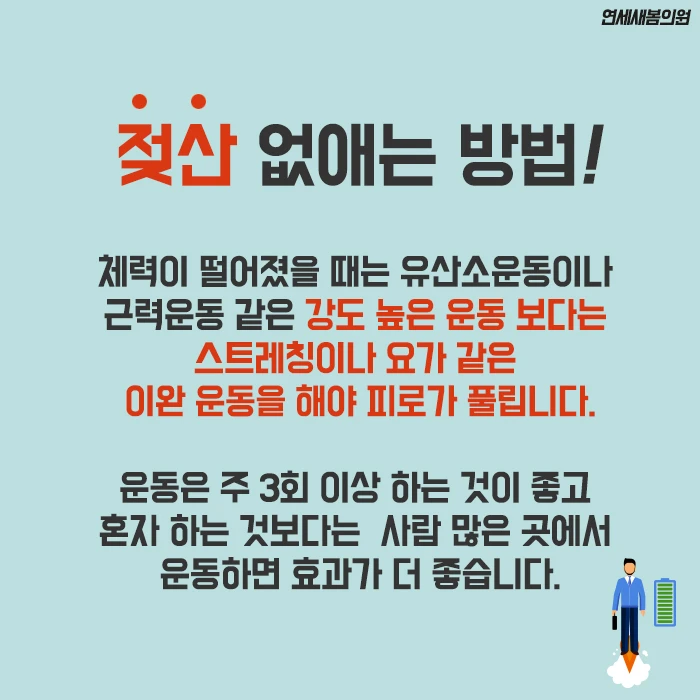
When your physical energy is depleted, rather than demanding activity such as aerobic exercise or strength training, the article recommends relaxing movement such as stretching or yoga. The article recommends exercising at least three times a week and suggests that, instead of exercising alone, doing so in places with other people, such as a swimming pool, gym or park, may be more effective.