
Original article
“I ate all three meals… and I am hungry again?
Do not eat! You are not really hungry!”
The article distinguishes between what it calls false and genuine hunger.
If you are not hungry but your mouth feels bored and you want something to eat,
the article suggests psychological hunger, or “false appetite.”
It says cravings within three hours of eating, without substantial activity, may reflect a hungry mind rather than a hungry body.
“False appetite” is described as the brain creating appetite
without the body actually needing food, making it a major obstacle to dieting.
False hunger means wanting food even when you are not hungry.
The article says falling sugar levels after a meal prompt hunger signals regardless of whether calories are lacking.
It describes the brain as detecting this and releasing ghrelin, an appetite hormone.
It warns that responding by eating without tolerating that moment can add stored fat and increase weight.
It also explains that stress can cause excessive cortisol release, increasing appetite,
encouraging cravings and promoting ghrelin secretion that it associates with false hunger.
http://tvcast.naver.com/v/1125398
(I Am a Body Doctor, broadcast September 21, 2016.)
I Am a Body Doctor: not all fat is the same! A surprising fact: could there be helpful fat that burns fat? White fat described as encouraging illness versus calorie-burning brown fat. Sean Lee's fat-burning animal-style exercises and three-meal plan: a fun, accessible way to exercise indoors. Just 15 minutes a day is presented as enough to change your body. Sean Lee's exercise method revealed! Special ideas for a healthier world: I Am a Body Doctor, broadcast Wednesdays at 11 p.m. [Original video description.]
tvcast.naver.com
What is the “false appetite” that keeps us eating even when full?
The program I Am a Body Doctor recently aired a discussion of false appetite.
Although we should stop eating when full, the article says false appetite
arises from imbalance in hormones released in the brain, as described above.
When we see favorite foods or foods we consider delicious,
the article says the stomach makes room for more despite already being full. Really?
Comedian Kim Soo-young tested this through a contrast examination of the stomach.
His stomach was already full after three servings of pork belly and two bowls of rice.
However, when he was shown three foods he liked,
his stomach began responding from the moment he saw them.
The empty space in the stomach increased as he ate!
Even while eating, the empty space kept increasing.
The identity of false appetite appeared before our eyes!
The article describes this as a startling result.
How can we distinguish genuine appetite from false appetite?
The article proposes a simple distinction.
If you feel hungry within three hours of a meal, drink a glass of water.
If you still feel hungry ten minutes afterward, it calls that genuine appetite; otherwise, false appetite.
One characteristic it identifies is craving strongly flavored food, such as sweet or salty food.
It also describes sudden hunger and a specific food coming to mind,
habitual or unconscious eating, and guilt afterward as characteristics of false appetite.
The original article states that hunger felt when stressed or irritated is “100%” likely to be false appetite.
It warns that eating whenever you cannot resist this hunger will make weight management unsuccessful.
What about genuine appetite?
The article describes genuine appetite as including stomach rumbling
or a gnawing feeling, and willingness to eat any type of food.
You are aware of the food while eating and can stop when full.
For appropriate weight management, it recommends distinguishing genuine from false appetite and adjusting food quantity accordingly.
It emphasizes recognizing whether hunger is sudden
or genuinely physical and responding appropriately.
The difficulty, however, is that false hunger can be as hard to tolerate as genuine hunger.
False hunger is described as habitual hunger.
If you have habitually responded to it
by eating, changing that immediately is not easy.
Support may also be needed to overcome it.
The original post says YONSEI SaeBom Medical Clinic uses its HCG hormone diet to address habits
of satisfying false hunger and to help maintain body shape.
Original illustrations & English text
The original artwork is preserved below, with English translations of the text in each illustration.

The two faces of appetite: false appetite. What is the false appetite that causes overeating?
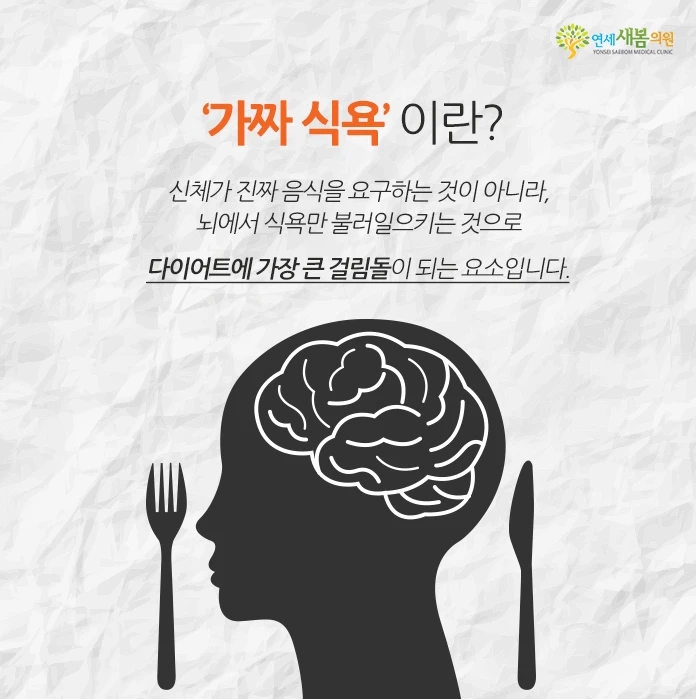
False appetite is described as appetite created by the brain when the body does not actually need food, making it a major obstacle to dieting.
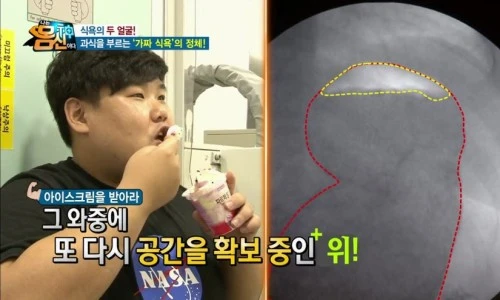
Even while eating, the stomach is making room again, says the television caption.
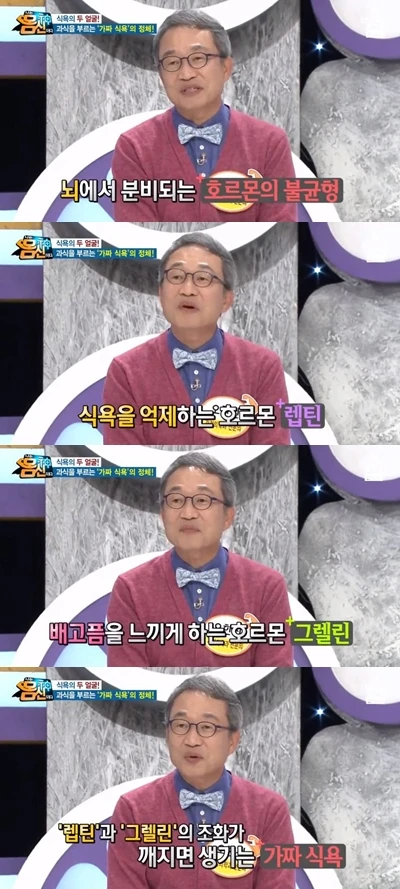
Imbalance in hormones released in the brain: leptin suppresses appetite; ghrelin makes us feel hungry. The program attributes false appetite to disrupted coordination between leptin and ghrelin.
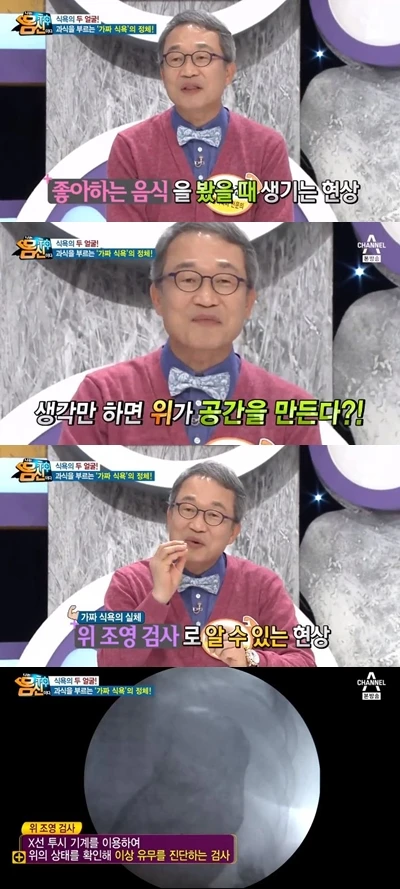
A response on seeing favorite foods: can simply thinking about them make space in the stomach? The program says this can be observed with a stomach contrast examination—an X-ray examination to assess the stomach and check for abnormalities.
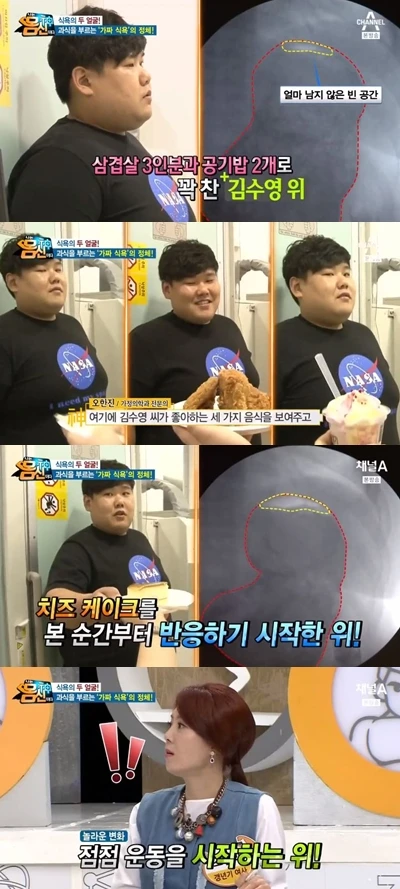
Kim Soo-young is full after three servings of pork belly and two bowls of rice, with little empty space left. Dr. Oh Han-jin, a family-medicine specialist, explains that three favorite foods will be shown. The stomach begins responding from the moment he sees cheesecake; its movement gradually begins.
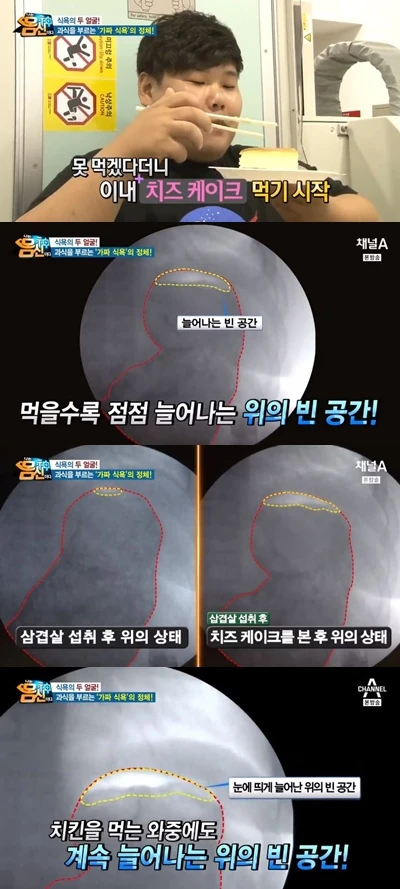
Despite saying he cannot eat more, he begins cheesecake. The program caption says empty stomach space increases as he eats. Images compare the stomach after pork belly with its appearance after seeing cheesecake; a further image shows noticeably increased space while he eats chicken.
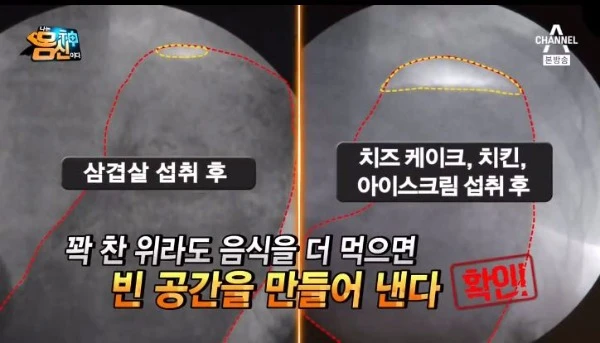
After pork belly versus after cheesecake, chicken and ice cream: the program says that even a full stomach creates empty space when more food is eaten.
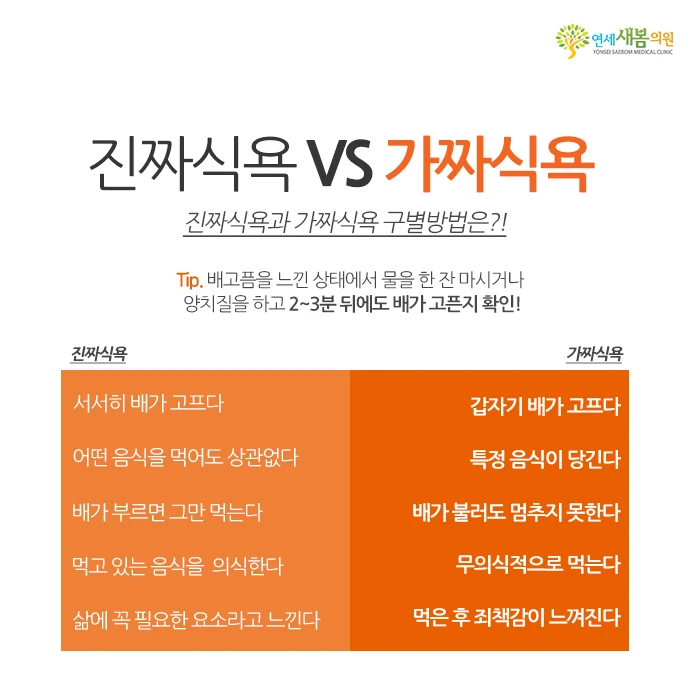
Tip in the graphic: when hungry, drink a glass of water or brush your teeth, then check after two to three minutes whether you still feel hungry. (The prose says ten minutes after water.) Genuine appetite: hunger develops gradually; any food is acceptable; stop when full; remain aware of eating; regard eating as an essential part of life. False appetite: hunger comes suddenly; crave a particular food; cannot stop even when full; eat unconsciously; feel regret or guilt afterward.

Successful weight management requires distinguishing false from genuine hunger and responding appropriately. The graphic says YONSEI SaeBom Medical Clinic’s HCG hormone diet helps change habits of satisfying false hunger and maintain body shape.